



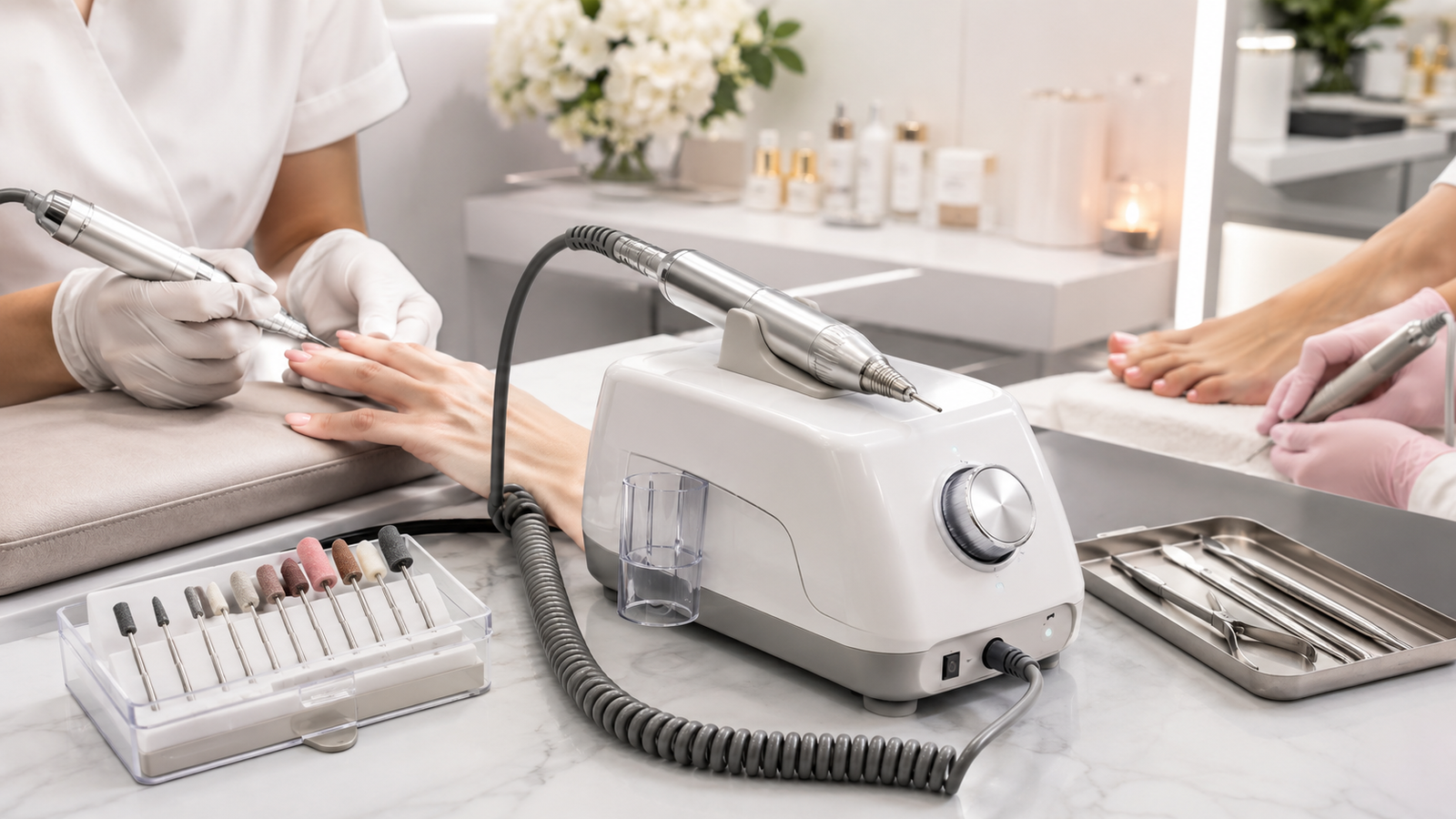
Nail drill machine – how to choose a model for home, salon, manicure, pedicure and podiatry?
A nail drill machine can completely change the speed and precision of manicure and pedicure work. A well-chosen nail drill helps prepare cuticles, clean the nail plate, remove gel polish, gel or acrygel, smooth the surface and work more accurately than with a hand file alone. A poorly chosen device, however, can tire the hand, vibrate, overheat, be too weak for salon use or feel too aggressive for a beginner.
The biggest mistake when buying a nail drill is choosing only by price or maximum RPM. A professional nail drill machine should match the way it will be used: at home, in a salon, for gel polish manicure, gel nails, pedicure or podiatry. A beginner needs a different device than a stylist working with several clients per day. A podiatry specialist needs a stronger and more stable system than someone who occasionally removes gel polish at home.
At Diana Beauty, the category nail drills and bits is a good starting point. There you can find devices and accessories for manicure, pedicure and professional salon work. A nail drill should be treated as a technical working tool, not just a small accessory on the manicure table.
What is a nail drill machine used for?
A nail drill machine is used for precise work on the nail plate, cuticles and styling product. Depending on the nail drill bit, it can be used to prepare cuticles, remove old gel polish, reduce gel or acrygel, smooth uneven areas, prepare nails for a new styling or perform selected stages of pedicure.
A nail drill machine can be used for:
- cuticle preparation in combined manicure or e-file manicure,
- removing gel polish,
- reducing gel or acrygel product,
- smoothing the surface of the styling,
- preparing the nail plate for base coat,
- correcting nail shape,
- pedicure work,
- faster and more organised salon work, because many manual filing steps become shorter.
A nail drill does not replace knowledge or technique. It gives excellent results in trained hands, but incorrect use can damage the natural nail. Too much pressure, the wrong bit, speed that is too high or an unstable hand can cause problems. That is why the choice of device should not be based only on power, but also on control.
First define the use: home, salon, pedicure or podiatry?
Before buying, answer one question: what will the nail drill be used for most often? This is more important than the price. Occasional home manicure requires a different model than daily salon work. For pedicure and podiatry, stability, handpiece comfort and stronger performance become even more important.
The choice can be simplified like this:
- for home use – simple, light nail drill with clear operation and smooth speed control,
- for beginners – stable model with comfortable handpiece and predictable performance,
- for manicure salon – stronger model with low vibration, good handpiece and longer working comfort,
- for gel and artificial product – stable device with enough torque,
- for pedicure – comfortable model for longer sessions and different bits,
- for podiatry – more professional and stable device for intensive use.
Someone who removes gel polish at home from time to time does not immediately need an advanced podiatry drill. A salon that works with several clients per day, however, should not rely on a very basic device made only for occasional home use.
Nail drill speed – is 30,000 RPM enough?
One of the most checked parameters is the speed of a nail drill machine. Product descriptions often mention 20,000, 30,000 or 35,000 RPM. In practice, speed matters, but it should not be the only criterion. Stability, handpiece quality, torque, smooth control and work comfort are just as important.
General guide:
- for gentle manicure a lower speed range is often enough,
- for gel polish stable performance and smooth control are important,
- for gel more power and a reliable handpiece are needed,
- for pedicure stability and correct bit choice matter a lot,
- for salon work maximum RPM is not enough; comfort during long use also matters.
An example of a salon-level direction is the Saeyang Marathon 3 Champion nail drill H37LSP white. This type of device fits work where stable performance is needed for manicure, pedicure and gel styling.
Power and torque – why speed alone is not enough
Many people ask only about RPM and forget about nail drill power and torque. A device can have a high maximum speed and still work weakly under pressure, vibrate, stop when pushed or feel uncomfortable on harder product. A good nail drill should continue working evenly and predictably.
In practice, the important points are:
- smooth speed regulation,
- stable performance with different nail drill bits,
- no jerking when removing product,
- comfort during longer treatments,
- low vibration level,
- handpiece that does not tire the hand quickly,
- suitability for manicure and pedicure.
For more intensive work, more professional models are worth considering, such as the Saeyang Marathon K38 PRO BS30 Brushless Nail Drill. Brushless models are especially interesting when stability, comfort and longer working time are important.
The handpiece – the most important part for work comfort
The handpiece of a nail drill machine is extremely important because the nail stylist holds it throughout the whole treatment. If the handpiece is too heavy, heats up, vibrates or sits poorly in the hand, the work becomes tiring very quickly. Even a good control unit will not help much if the handpiece is uncomfortable.
A good handpiece should be:
- light and ergonomic,
- stable at different speeds,
- low in vibration,
- comfortable during long treatments,
- easy when changing drill bits,
- well balanced,
- not overheating during normal use.
In salon work, the handpiece affects not only comfort but also precision. If the hand gets tired quickly, it becomes harder to control work around the cuticles and natural nail plate. That is why the handpiece is not a detail. It is one of the most important parts of the nail drill.
Cordless nail drill – who is it good for?
A cordless nail drill machine gives a lot of freedom of movement. It works well for mobile nail stylists, small workstations, salons where a clean table matters and anyone who does not want to be limited by cables. It is a practical solution, but working time, charging, stability and hand comfort should be checked before purchase.
A cordless nail drill is a good choice when:
- you work mobile,
- you want fewer cables on the workstation,
- you have little space on the table,
- you perform manicure in different places,
- you need a light and practical device,
- you want flexibility in your work setup.
An example is the Cordless nail drill white Saeyang Marathon K38 Crafien Mini. This is a good direction for people who want to combine mobility with a more professional working feel.
Nail drill machine for a beauty salon
A nail drill machine for a beauty salon should be chosen differently from a device for occasional home use. In the salon, daily workload, stability, ergonomics, fast bit changing, low vibration and comfort for many hours matter. The device must handle repeated use with different clients and different types of styling.
For a salon, it is best to choose a nail drill that:
- keeps stable speed,
- works well when removing gel polish and gel,
- does not tire the stylist’s hand quickly,
- has a comfortable handpiece,
- allows smooth regulation,
- works evenly without strong vibrations,
- fits manicure, pedicure and different drill bits.
For salon work, models such as the Saeyang Marathon 3 Champion H37LSP can be considered. Stronger brushless solutions are also worth looking at when the salon works intensively and needs more stability during longer treatments.
Podiatry drill – when is a standard model not enough?
A podiatry drill is designed for more demanding work on feet and longer treatments. In podiatry, stability, comfort, precision, a good handpiece and safe long-term work are crucial. A simple nail drill for basic manicure may be too weak or uncomfortable for this type of use.
A podiatry drill is important when the salon works with:
- professional pedicure,
- podiatry treatments,
- longer foot care services,
- more demanding surfaces,
- services where stability and control are essential,
- clients who require more precision.
For this profile, the category podiatry drills is worth checking. Also look at podiatry chairs, because a good drill is only one part of a professional foot care workstation.
Nail drill for beginners – what should you avoid?
A nail drill for beginners should above all be predictable. Someone learning to work with an e-file needs control, smooth speed regulation, a comfortable handpiece and calm performance. A device that is too aggressive, the wrong bit or lack of technique can quickly damage the natural nail plate.
For beginners, it is better to avoid:
- the cheapest devices with unstable performance,
- nail drills with strong vibration,
- heavy or uncomfortable handpieces,
- no smooth speed control,
- working with random bits without knowing their purpose,
- too high speed around cuticles,
- too much pressure on the natural nail plate.
A beginner should first learn control of movement, pressure, working angle and bit choice. A nail drill should make the work easier, but it does not replace training and practice.
Which nail drill bits should you choose?
Nail drill bits determine what the nail drill actually does. The device is the base, but the bit makes contact with the nail, cuticle or artificial product. A different bit is used for cuticles, a different one for removing gel polish, another for reducing gel and another for smoothing the surface.
Common uses of nail drill bits:
- cuticle bits – for precise work around the nail fold,
- bits for gel polish removal – for removing colour and product layers,
- bits for gel – for faster work on harder product,
- smoothing bits – for evening the surface,
- pedicure bits – for foot care according to the intended use,
- sanding caps – for selected pedicure and smoothing stages.
Nail drill bits should never be chosen randomly. Shape, grit, material and technique must match the stage of the treatment. A poorly chosen bit can heat up, pull, damage the styling or affect the natural nail plate.
Safe work with a nail drill
Safety is essential, especially around the natural nail plate and cuticles. Working with a nail drill machine requires a calm hand, correct bit, speed control and minimal pressure. A nail drill should not be used like a hand file that is pressed harder to get a faster effect.
Important safety rules:
- do not press the bit too hard,
- do not work too long in one place,
- adjust the speed to the working stage,
- use every bit according to its purpose,
- control heat and client comfort,
- do not work aggressively on the natural nail plate,
- use clean and well-functioning bits,
- disinfect and organise tools according to salon procedure.
If the client feels heat, burning or pain, stop and check the technique. The nail drill is meant to increase precision, not to cause discomfort.
Nail drill machine and manicure workstation
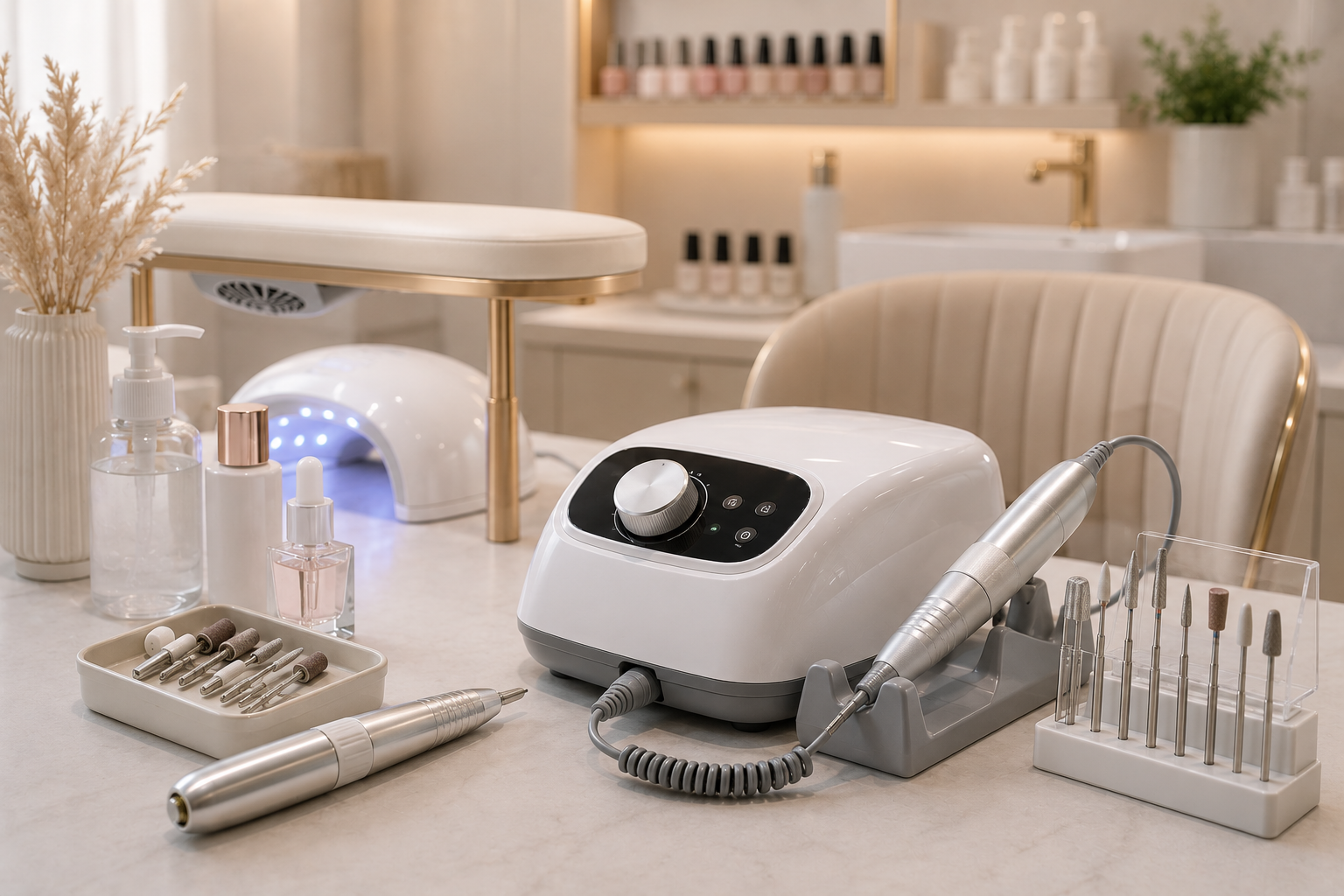
A nail drill does not work separately from the rest of the workstation. Professional e-file manicure requires an organised table: good lighting, dust collector, drill bits, files, prep products, styling products, towels, disinfection and a comfortable hand position for the client. Even a good nail drill becomes less pleasant to use in a chaotic setup.
For a manicure workstation, it is useful to have:
- nail drill within easy reach,
- holder or organiser for drill bits,
- good lighting,
- UV LED lamp for curing the styling,
- space for dust and waste,
- disinfection products,
- separate place for clean and used bits,
- ergonomic stool for the stylist.
When building a workstation, it is logical to combine nail drills and bits with LED and UV lamps for nails. The nail drill prepares and corrects the styling, while the lamp ensures correct curing of light-cured products.
Common mistakes when choosing a nail drill
When choosing a nail drill, many people make the same mistakes. Most often, this happens because the device is bought without analysing the services. A nail drill for home, salon and podiatry does not need to be the same. The difference is in working intensity, requirements, handpiece and comfort.
Common mistakes include:
- choosing by price only,
- choosing by RPM only,
- ignoring handpiece quality,
- not checking vibration,
- buying a model too weak for salon work,
- buying a podiatry-level device without real need,
- working with the wrong bits,
- not organising clean and used bits separately,
- not planning an ergonomic workstation,
- not learning correct e-file technique.
A good nail drill should match the services. Someone who mainly performs gel polish manicure needs a different setup than someone working with pedicure and podiatry. The purchase should match real daily practice, not only an attractive product description.
How to choose a nail drill by work level?
The choice becomes easier when users are divided into three groups: home use, salon work and advanced professional work.
For home and beginners:
- light construction,
- easy operation,
- smooth speed regulation,
- low vibration,
- safe work during basic manicure.
For a manicure salon:
- stable performance for several hours,
- comfortable handpiece,
- good speed range,
- work with gel polish and gel,
- fast bit changing,
- comfort for stylist and client.
For pedicure and podiatry:
- stronger and more stable construction,
- high comfort during longer treatments,
- suitable handpiece,
- work with different bits,
- ergonomic workstation,
- device matched to foot care services.
For a complete workstation, you can also check the category Beauty Salon, because the nail drill is only one part of a larger salon system.
Products and categories worth checking
When choosing a nail drill, it is worth comparing both manicure models and more professional pedicure or podiatry directions. Good drill bits and the rest of the workstation are also important.
- Nail drills and bits – main category for devices and bits for manicure and pedicure.
- Cordless nail drill white Saeyang Marathon K38 Crafien Mini – practical option for mobile work and flexible workstations.
- Saeyang Marathon 3 Champion nail drill H37LSP white – model for salon work in manicure and pedicure.
- Saeyang Marathon K38 PRO BS30 Brushless Nail Drill – direction for stable performance and more professional use.
- Podiatry drills – category for more intensive pedicure and podiatry work, including stronger professional models.
- Nails – products and accessories for a complete manicure station.
- LED and UV lamps for nails – devices for curing gel polish, gel and light-cured products.
- Podiatry chairs – solutions for pedicure and podiatry practices.
- Beauty Salon – main category for complete beauty salon equipment.
Nail drill machine – key conclusion
How to choose a nail drill machine? Start with the use: home, salon manicure, pedicure, gel, gel polish or podiatry. Then compare RPM, power, handpiece, vibrations, power supply, cordless work and compatibility with drill bits.
For beginners, control, smooth regulation and stable, calm work are the most important. For salon use, ergonomics, durability, comfortable handpiece and longer working time matter more. For pedicure and podiatry, stronger construction, comfort during longer treatments and the right drill bits are even more important.
The best nail drill machine is not always the most expensive model. The best choice is the device that matches your services, work speed, experience and workstation. A well-chosen nail drill shortens manicure time, increases precision, reduces hand fatigue and raises the professional level of the salon.
Which nail drill is good for beginners?
For beginners, a stable, light nail drill with smooth speed regulation and comfortable handpiece is best. Control and low vibration are more important than maximum power.
Is 30,000 RPM enough for a nail drill?
For many manicure services, 30,000 RPM can be enough. Still, RPM alone does not determine quality. Stability, handpiece, torque, drill bit and technique are also important.
What is the difference between a home nail drill and a salon nail drill?
A home nail drill can be simpler and used less intensively. A salon nail drill should be more stable, more comfortable, quieter and suitable for longer treatments with clients.
Is a cordless nail drill worth it?
Yes, especially for mobile stylists, small workstations or salons that want fewer cables. Pay attention to battery life, charging and device stability.
Which nail drill is suitable for pedicure and podiatry?
For pedicure and podiatry, choose a stronger, more stable model with a comfortable handpiece and good performance during longer treatments. A simple home nail drill may not be enough for this type of work.
Related Posts
Aftercare after keratin, hair botox and nanoplasty should not always look the same, because each treatment works on the hair in a different way. Nanoplasty focuses mainly on strong smoothing and straightening, keratin and protein treatments support hair structure and smoothness, while hair botox is mainly about repair, softness, shine and reducing frizz.
In this guide, we explain how to care for hair after salon treatments, which shampoo and mask to choose, what to avoid after nanoplasty, keratin and hair botox, how to wash the hair, how to dry it and which mistakes can shorten the effect of the treatment. A good home routine should support the salon result instead of weakening it.

A cosmetic chair is one of the most important pieces of equipment in a beauty room. It affects client comfort, specialist ergonomics, interior appearance, treatment speed and the professional impression of the whole salon. A well-chosen chair makes facial treatments, lashes, brows, permanent make-up, massage, pedicure, podiatry and many other beauty services easier to perform.
In this guide, we explain how to choose a cosmetic chair for a beauty room: when a manual model is enough, when a hydraulic chair works better and when investing in an electric cosmetic chair makes sense. We cover adjustment, number of motors, upholstery, stability, armrests, footrests, dimensions, cleaning, workstation ergonomics and the most common mistakes when buying a treatment chair.
Head Spa in a hair salon is a service that combines scalp care, washing, massage, relaxation and a professional beauty ritual. For the client, it is a premium experience. For the salon, it is a chance to increase the value of each visit, improve client retention and stand out from ordinary hair washing services.
In this guide, we explain how to build a Head Spa service: what type of workstation you need, how to choose a Head Spa wash unit or wash bed, which cosmetics to use, how to plan the treatment protocol, how to create packages and what mistakes to avoid when introducing Head Spa into a hair salon or beauty salon.
How to set up a beauty salon from scratch so that it is functional, aesthetic, comfortable for the client and practical in daily work? Good beauty salon equipment is not only a chair and a lamp, but a complete system: cosmetic furniture, treatment devices, stools, trolleys, lamps, tools, accessories, nail products, pedicure equipment, workstation organisation, hygiene and a logical room layout.
In this guide, we explain how to plan beauty salon equipment step by step: from choosing services, treatment chairs, lighting and beauty devices to manicure, pedicure, podiatry and a practical starter checklist. This helps avoid random purchases and build a salon that looks professional and truly supports daily work.

Gel polish wrinkles, does not cure or lifts from the nail? This is one of the most common problems in gel polish manicure, both at home and in the salon. The cause may be a colour layer that is too thick, the wrong UV LED lamp, curing time that is too short, poor nail plate preparation, product touching the cuticles, a greasy nail surface, dust residue or incorrect base and top application.
In this guide, we explain why gel polish wrinkles, does not cure or peels off, how to recognise a technical mistake and how to improve manicure durability. You will learn the role of the UV LED lamp, timer, lamp power, motion sensor, nail preparation, nail drill, layer thickness, free edge sealing and correct working order.

A hairdressing wash unit is one of the most important elements of salon equipment, because it affects client comfort, the ergonomics of the hairdresser’s work, the organisation of the washing area and the professional appearance of the entire interior. Many services start or end at the wash unit: hair washing, toner rinsing, colouring, hair repair, botox, keratin, nanoplasty and after-treatment care.
In this guide, we explain how to choose a hairdressing wash unit for your salon, what to check before buying, how a fixed wash unit differs from a portable solution, when a barber wash unit is worth considering and how to evaluate the basin, chair, neck support, drainage, installation, style and working comfort. This makes it easier to choose a model for a hair salon, barbershop, beauty studio or smaller treatment room.

A UV LED nail lamp is one of the most important devices in manicure and nail styling, because it affects work comfort, service speed, even curing and the durability of gel polish, gel, builder gel and other light-cured products. The choice of a lamp should not depend only on wattage, but also on LED technology, light distribution, timer, motion sensor, low heat mode, tunnel shape, mirrored base and build quality.
In this guide, you will learn how to choose a UV LED nail lamp for home use, mobile nail styling and professional salon work. You will discover when a 48–54W lamp may be enough, when 65–72W is a better choice, what the difference is between a wired and cordless nail lamp, why the sensor and timer matter, and how to choose a lamp for gel polish, gel nails, pedicure and daily work with clients.

Which hair treatment should you choose when the hair is dry, frizzy, damaged, blonde, curly, fine or hard to style? Nanoplasty, hair botox, keratin, protein and hair lamination can all improve the appearance of the hair, but each treatment has a different purpose, different intensity and different role in professional salon work.
In this guide, we compare the most important professional hair treatments by desired effect: straightening, smoothing, repair, anti-frizz control, reconstruction, shine, volume control and care for blonde or curly hair. This helps you choose based on what the hair really needs, not only on a popular treatment name.

Nanoplasty or keratin straightening is one of the most common questions from clients who want smoother, shinier, less frizzy and easier-to-style hair after every wash. Both treatments can create a beautiful smooth finish, but they differ in straightening power, treatment character, suitability for each hair type and the final result that can realistically be expected.
In this guide, you will learn when to choose nanoplasty, when keratin hair straightening is the better option and when protein straightening or a repairing treatment should be considered first. You will discover which treatment is suitable for thick, wavy, frizzy, blonde, bleached, dry, damaged, curly and fine hair.

Hair botox treatment is a professional repairing and smoothing service designed to improve the look and feel of dry, frizzy, dull, weakened, bleached or hard-to-manage hair. Unlike nanoplasty, its main goal is not maximum straightening, but repair, hydration, softness, shine and frizz reduction.
In this guide, you will learn what botox for hair is, when to choose this treatment, how it differs from nanoplasty and keratin straightening, which type of hair botox is best for blonde, curly, dry or heavily damaged hair, and how to care for the hair after the treatment to maintain softness, elasticity, shine and a healthy-looking finish for as long as possible.